Tuesday, October 9, 2012

As SA’s colours rise with SAA, so do the losses

Bookmark and Share

09 Oct 2012 | Tony Leon | Original Publication: BDlive
SAA may not just be a drag on growth but may also contribute to the widening of the current account deficit, writes Tony Leon

IN 1960, in the first ever televised US presidential debate, Richard Nixon showed up with five o’clock shadow and looked shifty compared with the uber-cool John F Kennedy; in 1988, George Bush looked at his watch during his encounter with Bill Clinton; in 2000, Al Gore sighed audibly in his TV duel against Bush’s son, George. All three went on to lose the presidential election a month or so later. On such twitches of body language the hinges of a nation, and the world’s sole, albeit declining, hyper-power would appear to turn.

Last Wednesday, in his first debate with challenger Mitt Romney, President Barack Obama posted a "subprime" performance. He looked peevish and was widely accused of being defensive and, in place of his fluid eloquence of four years before, of showing up with a grimace and "looking as though he would be rather anywhere else".

But if a different Obama showed up in Denver, so did a different Romney.

Gone was the right-wing Tea Party-appeasing hardliner. In his place was the Massachusetts moderate. It is entirely in the realm of conjecture as to which Romney will present himself in the event that he comes from behind and beats Obama next month.

When Romney was debating Ted Kennedy in their contest for the US Senate in 1994, the liberal senator killed Romney’s chances with a memorable put-down. At that time — a position he has reversed several times subsequently — on the issue of abortion, Romney proclaimed himself "prochoice". "No you’re not," snapped Kennedy, "as with everything, you’re multiple choice."

Obama never brought to the debate any of the sound and fury of his barrage of negative advertising against Romney, which portrays the Republican as a vampire capitalist job-destroyer from his time as the founder of Bain Capital, the private equity firm that netted Romney a fortune of about $250m.

There is a direct connection between Bain Capital and the continuing misfortunes of South African Airways (SAA). One of Romney’s closest associates and a co-founder of Bain Capital is the notorious Coleman Andrews, who between 1998 and 2001, pocketed R232m from the grateful and unsuspecting South African taxpayer for 20 months’ work as SAA CEO. Now, 11 years and four CEOs later, SAA has returned to the fiscus for another R5bn bail-out, this time dressed up as a "guarantee". David Gleason estimates that since 1997, the taxpayer has stumped up more than R16bn to keep the flag flying. Yesterday’s revelation that the airline’s balance sheet is far redder, to the tune of about R1.25bn in losses last year, than previously thought suggests that the ailing airline will revisit, soon enough again, the government trough.

Relax, it could be worse: in Argentina, state carrier Aerolineas Argentinas loses a whopping $2m a day, making its annualised losses about five times worse than the leaked balance sheet of SAA suggests.

The CEO of Aerolineas proclaimed with nationalist fervour: "The colours of the Argentinian flag rise with every takeoff." And, like SAA, so do the losses. I was struck on my recent flight homeward to read the remark of SAA (now former) CEO Siza Mzimela: "We will continue to be a catalyst for economic growth in SA and the rest of the continent." On current trends, SAA may not just be a drag on growth but may also contribute to the widening of the current account deficit.

All this raises the question of the role of the state in the business of owning airlines. The old Tory adage that "the business of government is not the government of business" has been upended in the wake of the financial crisis, which put the kibosh on the light-touch, low-tax regime in which the Bain Capitals of this world flourished and wreaked their trail of "creative destruction".

During my years in Argentina, when we increased the tourist arrivals from there to here by more than 100%, SAA was a vital and valued partner. So, I am forced to admit, given that its political head, Marthinus van Schalkwyk, is my political nemesis, was SA Tourism, which, in a sea of state dysfunction, is an island of professional excellence.

But neither of these facts suggests that state supervision has improved matters in government-owned entities. All of which leads back to Andrews who, in the event of a Romney win, could be a very big figure in the next US administration. In Parliament in June last year, Jeff Radebe — today in the firing line over various failures on his justice watch but who was then minister of public enterprises — memorably tore into then Transnet CEO Saki Macozoma for the multiple lapses of corporate governance around the Andrews appointment.

Macozoma, Radebe and Andrews have all moved onward and upward since then. Meanwhile, SAA and its state owner are nose-diving over the fiscal cliff and widening our national deficit, the one matter Obama did talk about last Wednesday.

• Follow Tony Leon on Twitter: @TonyLeonSA.

Sunday, October 7, 2012

Parallels between apartheid and Argentina

Bookmark and Share

07 Oct 2012 | Tony Leon | Original Publication: Financial Times

Argentina is heading, and not for the first time, over an economic cliff as the population races to dump pesos for dollars and a zealous government fights back through draconian currency controls, manipulating economic data and import-suppression measures.

At the UN Ms Kirchner hit back at Christine Lagarde, IMF managing director, who had threatened to “red card” Argentina because of its fudged national statistics. Invoking “sovereign independence” to justify Argentina’s outlier behaviour, Ms Kirchner sounded like the vanquished white president of yesteryear whose UN representative encouraged the world “to do its damnedest”, which it duly obliged to do.

A crucial difference is that Ms Kirchner received an emphatic democratic mandate in October last year, something no pre-1994 South African government ever won. And Argentina’s president is hardly alone among political leaders in displaying symptoms of political hamfistedness.

South Africa, whose $400bn resource-dependent economy almost exactly matches Argentina’s, also received its own yellow card from Moody’s in September when its government bond rating was downgraded one notch. The rating agency cited concerns about political stability amid labour unrest and socioeconomic stresses. In South Africa there is much talk about nationalisation. In April, Ms Kirchner seized control of the oil company YPF from Spain’s Repsol. In both cases, the effect on foreign investment is chilling.

The writer is the former South African ambassador to Argentina

Tuesday, October 2, 2012

Lessons from the Boks for SA and Argentina

Bookmark and Share
02 Oct 2012 | Tony Leon | Original Publication:  BDlive

The response of South Africa and Argentina to warnings by international financial institutions and ratings agencies is revealing, writes Tony Leon

MY WEEKEND return from three years away as SA’s ambassador to Argentina coincided with the two countries’ rugby teams competing again against Australia and New Zealand, respectively, in the near-final rounds of the Rugby Championship.

I was delighted to see the Springboks recover their mojo — and thump Australia at Loftus. Argentina this time put in a much less assured performance against the All Blacks in La Plata. These were tough matches with tight refereeing.

Away from the playing fields, another unforgiving referee was dishing out some yellow cards and SA and Argentina were at the receiving end. Moody’s downgraded SA’s bond rating, citing concerns for political stability, labour unrest and socioeconomic stresses. The same rating agency also downgraded 30 Argentinian banks from "stable" to "negative", citing "high amounts of official intervention in the economy".

Argentina’s eccentric economic policies also received the attention of the International Monetary Fund (IMF) last week. Its dubious national statistics (which famously underreport inflation by about 50%) received the threat of a red card.

The response of both sovereigns to these warnings was revealing. Argentinian president Cristina Fernandez de Kirchner used her appearance last week at the United Nations General Assembly to thunder back at the IMF and announce that — despite bequeathing to the world such football gods as Diego Maradona and Lionel Messi — "Argentina is not a soccer team. It is a sovereign nation that takes decisions in a sovereign way." Interestingly, from the same global podium last week, President Jacob Zuma chose not to address burning topics, such as the recent Marikana mine massacre, which clearly provided the trigger for the Moody’s downgrade. He stuck to safer matters, such as the universality of the rule of law. But to transpose Andy Warhol’s famous dictum, when you have "15 minutes of fame" on the world stage, you shouldn’t squander them.

Aside from defying or ignoring the red and yellow cards from these pesky (to the presidents) but hugely influential (to the markets) international arbiters, SA and Argentina have much in common. Our economies and populations are almost identical in size and we are both extractors of natural resources. In Argentina’s case, its rocket-like growth over the past decade, at about 9% a year, has now slowed due to unsustainable and ultraloose fiscal and monetary policies. Still, as Bill Clinton recently noted at a dinner in Buenos Aires, as one of the top three producers of soybeans in the world — the globe’s cheapest form of protein — you shouldn’t bet against Argentina. "We don’t know how consumption patterns in the world will change," opined the former US president, "but everyone in the world has still got to eat".

The Centre for Development and Enterprise published a study on Brazil and its lessons for SA last week. Indeed, one of my "takeaways" from South America is the huge significance of Brazil for the world. There are only three countries on the planet with a land mass of more than 8-million km², population of more than 200-million and an annual gross domestic product of more than $2-trillion: the US, China and Brazil.

But there are other nations breathing down the necks of both Argentina and SA and which prove that the hyperconnected and ultracompetitive world waits for no country, and complacent assumptions about the future flowing from the past are utterly unreliable. Two other South American countries enter the frame here.

While SA waits for striking miners, leaden managers and clueless policy makers to get their act together and salvage our mining sector, it is instructive to look at Peru. In 2000, SA was the largest gold producer in the world, producing 16.6% of global output. Far behind was Peru at 5.2%. Last year, SA’s production slumped to fifth place at 7%, while Peru’s increase to 5.6% of world output brought it within our range. Now South American mining mavens say Peru is well placed, with careful policies and significant reserves, to overtake us.

Colombia also offers no end of lessons for Argentina and the world. The received wisdom was always that Argentina would remain the largest Spanish-speaking economy in South America and the second-biggest after Brazil. But, hang on, what is the former narco-state of Colombia now doing? If you take the more reliable measure of purchasing power parity (rather than the dubious — in Argentina’s case at least — official rate of exchange), Colombia’s current economic size of $478bn now exceeds Argentina’s. Perhaps the clue here is that while Kirchner earlier this year seized control of the foreign ownership of Argentina’s oil giant, YPF, Colombia went about concluding a free-trade agreement, and investor protection codes, with the US.

On Saturday, Springbok coach Heyneke Meyer listened to his critics, carefully studied his competition and changed key players and his game plan. SA won in splendid style. It’s quite a good approach for the countries competing in the Rugby Championship to try out on their economies as well.

• Follow Tony Leon on Twitter: @TonyLeonSA.

Sunday, September 30, 2012

Leon returns happy with Argentine success

Bookmark and Share

30 Sep 2012 | Warda Meyer | Original Publication: Sunday Argus


Saturday, September 29, 2012

Tony Leon se veglus nie geblus

Bookmark and Share


29 Sep 2012 | Hanlie Retief  | Rapport

Amen.

Dis Tony Leon se antwoord op Barney Pityana se kaalvuis-tirade die afgelope week teen die ANC as ’n onverantwoordelike regering “sonder enige kollektiewe intelligensie om te verstaan wat gedoen behoort te word”.

Hy lag so ’n bietjie daarvoor, sê Tony oor ’n dowwerige telefoonlyn uit Buenos Aires.

“Toe ons ander dit gesê het, was ons morele en politieke uitgeworpenes. So, mnr. Pityana: Ek weet wat jy van mý gesê het ’n paar jaar terug. En jy’t Dennis Davis ’n rassis genoem oor jy nie met hom saamgestem het nie.

“Nou’s jou kritiek op die regering veel erger.”

Dié oud-DA-leier se drie ambassadeursjare in Argentinië het hom dalk ’n staatsman en diplomaat gemaak, maar al die bankette en seremonies kon die “Veg terug” in Tony allermins blus.

“Ek dink die stemming in Suid-Afrika het die laaste paar jaar verander. Ek was destyds ’n stem in die wildernis en in baie gevalle is ek reg bewys. En nou?

“Die hele Suid-Afrika is nou in fight-backmode.”

Die joernalis Justice Malala skryf in 2007: “Hy (Tony Leon) was openlik krities toe baie net in fluisterstemme gepraat het.”

Ná seker 200 afskeidspartytjies (“die Argentyne gaan groot met dié soort goed”) was dit vir Tony en Michal Leon dié naweek “adios Argentinië” in ’n SAL-vliegtuig op pad huis toe. In die romp was ’n aangenome Argentyn, die worshond Julio, nadat hul geliefde Jemima haar einde teëgekom het in ’n dammetjie oorkant die Leons se dakwoonstel in Buenos Aires.

So, vra ek hom, kry Suid-Afrika ’n ander Tony Leon terug as die een wat pres. Zuma drie jaar terug Argentinië toe gestuur het?

“Gawer, sagter, meer diplomaties? Nee. My nommer-twee by die ambassade sê hy ken nou óók my ekstreme vlakke van ongeduld!

“Kollegas en ander ambassadeurs het nogal gesê ek’s ’n vars bries, seker oor ek presies sê wat ek dink.”
Hy’t darem niks onbesonne aangevang nie, skerts Tony, maar die seremoniële rituele van diplomasie kan erg vervelig raak. Soos die keer toe hy ’n minister na afgeleë Jujuy vergesel. Alles was laat – die vliegtuig, die ete wat eenuur die nag begin het. Al wat vinnig was, was die Spaans.

Halfvier het hulle gaan slaap om sewe-uur weer te begin met seremonies ... “Terug in Buenos Aires het ek gewonder: Is dit nou wat dié job behels?”

Dan byt Tony maar op sy tande en hou die SA vlaggie hoog.

Die Buenos Aires Herald, Suid-Amerika se oudste Engelse koerant, het laas Sondag in ’n lang artikel spesifiek verwys na Leon se transformasie van doemprofeet tot rasieleier ... en watter fyn balans hy kon handhaaf tussen die openbare en private sektore.

Al was dit net drie jaar, het sy ambassadeurskap hom ingrypend verander: “Profoundly.”

Toe Zuma hom die pos aangebied het, het Zuma gesê dis belangrik dat ook nie-ANC-lede Suid-Afrika se gesig na die wêreld word.

“Mooi woorde, maar toe ek oor daai ambassade-drempel tree, hét ek gewonder hoe ek dit gaan regkry, want ek verteenwoordig skielik ’n regering waarmee ek nie saamstem nie. Maar ek moet sê, dit was nie een keer ’n probleem nie, wat net weer bevestig het: Daar’s ’n wêreld se verskil tussen die belange van ’n land en dié van ’n party. Ek het nooit ’n krisis van gewete beleef nie. Bygesê, ’n ambassadeurskap in Harare of Tel Aviv sou ’n heel ander storie gewees het.”

Daar’s ook dinge wat nié vir Tony verander het nie.

Soos sy twee linkervoete. Drie jaar in Buenos Aires en señor Leon tango stééds nie. “Ek kon skaars dans op my troue. Maar ek het darem 27 tango-vertonings saam met gaste deurgesit.”
Tony Leon with the President of Argentina -
Cristina Fernández de Kirchner
Sy Sandton-Afrikaans is ook steeds strate beter as sy sypaadjie-Spaans, erken hy. Maar Tony het vasgebyt, nooit vertalers gebruik nie en self sy Spaanse toesprake voorgelees. Michal, spog hy, praat al Spaans soos ’n portenho, ’n plaaslike inwoner.

Ná al die Argentynse asado’s is die Leons ook vir eers klaar met rooivleis. As jy vir ’n Argentyn ’n bord kos gee sonder beesvleis tel dit nie as ’n ete nie, grap hy. “Dis seker nie ’n gewilde ding om te sê nie, maar asado’s is in ’n ander liga as ons braaie. Elke stukkie vleis word opgedien sodra dit gaar is. Dis heerlik, jy eet bietjies-bietjies, en ná die tyd voel jy soos ’n luislang.”

Tony is byna klaar met sy nuwe boek, The Accidental Ambassador – From Parliament to Patagonia.

“Hoe sê hulle? As jy dit nie geskryf het nie, het dit nie gebeur nie. Dis lig en humoristies en vertel hoe ek en Michal so half- toevallig deel geword het van hierdie geheime gilde van diplomate en ons interaksies met al die hoëkop-gaste uit Suid-Afrika.”

Hy skryf oor hoe hy ’n vlieg op die muur was een nag toe oudpres. F.W. de Klerk en pres. Cristina Kirchner ’n 40 minute-gesprek gehad het.

“Dit was ’n maand ná haar man (die vorige president, Néstor Kirchner) se dood en ek moes notas maak.”

In die boek raak Tony glo erg krities oor Kirchner se ekonomiese beleid. “Argentinië se onortodokse ekonomiese beleid is geen geheim nie en dit kom onder skoot, maar meer wil ek nie nou sê nie. Ek’s nog ambassadeur vir ’n paar dae,” wikkel hy hom sjarmant daaruit.

“Middelorde-lande soos ons en Argentinië moet maar die ekonomiese wêreld se reëlboek volg, anders kry jy pak.”

Hy’s ook allermins die eerste eks-ambassadeur wat kritiek het op sy gasheerland. Hy noem die voorbeeld van Christopher Meyer se omstrede memoirs ná sy tyd as Britse ambassadeur in Amerika in die dae van Blair en Bush.

“Deel van ’n ambassadeur se werk is om krities te wees. Min. Maite Nkoana-Mashabane het altyd vir my gesê: ‘Moenie vir my die goed vertel wat ek op CNN kan sien nie.’”

Tony stem saam met Zuma se onlangse erkenning dat Suid-Afrika se aansien in die buiteland afneem.

Toe hy die TV-beelde van die Marikana-slagting sien, kon hy dit nie glo nie. “Ek het gedink ek kyk na iets uit die 1960’s. Bygesê, hier langsaan in Brasilië is 120 mense in ’n tronk-opstand dood.

“Sulke dinge gebeur oral. Destyds, met Boipatong, het die hele wêreld nog ’n belang gehad het in ons nuwe demokrasie. Nou’s ons maar net een van baie lande en as iets soos Marikana gebeur, moet ons weet: Die wêreld se welwillendheid, en ons morele kapitaal, raak op.”

’n Piesangrepubliek, noem Julius Malema Suid-Afrika – nogal ’n term met sy oorsprong in Suid-Amerika. Nee, sê Tony, ons is veel eerder ’n vrugteslaai “met goeie én vrot vrugte – waarvoor Malema maar net in die spieël hoef te kyk”.

Toe Juju almal vroeër vanjaar op hol gehad het, twiet Tony twee reëls uit ’n Yeats-gedig: “The best lack all conviction, while the worst are full of pas- sionate intensity.”

Ja, lag hy nou daaroor: “Ja ... Yeats ... Thabo Mbeki se digter, nou van toepassing op Malema!”

Ernstiger: As daar een ding is wat hy graag wil doen, is dit om jong Suid-Afrikaners te oortuig dat politiek ’n edel, ordentlike beroep kan wees. Nié laelewe nie.

Jong leiers moet buite die partypolitieke konteks ontwikkel word – iets wat sy tyd (“een van die beste van my lewe”) by die Harvard-universiteit se John F. Kennedy School of Government by hom ingeskerp het.


Michal and Tony Leon in the historical Cordoba, Argentina
 
Al waaroor hy spyt is in sy lang, politieke loopbaan is daardie gewraakte “Fight back”-slagspreuk in die 1999-verkiesing, het Tony laas week aan die Herald gesê. Ja, sê hy nou, “maar in die konteks van daardie tyd was dit wel toepaslik. Waaroor ek éintlik jammer is, is dat my politieke lewe en bydrae aan dié twee woorde gekoppel word. Dis darem veel meer werd as dit.”

Die “konteks van daardie tyd”, sê hy, was die greep van die ANC op die swart stem en ’n versplinterde opposisie. “Ons moes eers ons posisie konsolideer. As ons dit nie gedoen het nie, het die DA nie nou bestaan nie.”

En wat lê in Tony se toekoms?

Weer partypolitiek? Die toespraak-rondomtalie soos sy naamgenoot Tony Blair?

“Nee, nie partypolitiek nie. Die DA én ek het aanbeweeg. Ek sal altyd in die opposisie bly, maar mens kan kreatiewe dinge doen sonder om ’n party-banier te swaai.”

Daar wag ’n Business Day-rubriek, lesings, iets in die sakewêreld. En, altyd, ’n kritiese oog.

In die SAL-vliegtuig dié naweek sal Tony Leon vele hoogtepunte onthou uit die land van Peron en die Pampas. Sy besoek aan die boere-gemeenskap in Patagonië en dié se versugting na ’n Afrikaanse onderwyser; die première van Invictus met Joost van der Westhuizen se “fantastiese toespraak” wat 300 oud-Pumas laat trane sluk ...

Die handelsgroei tussen die twee lande, “iets waarop ek gefokus het, het gegroei tot meer as R1,3 miljard”.

“Toerisme van Argentinië na Suid-Afrika het in een jaar met 122% toegeneem.”

Mens waardeer glo eers jou eie land as jy in ’n ander een gaan bly – en so was dit met Tony Leon.

“Toe ek weg is ná 20 histeriese jare in die politiek, moes ek afstand kry, ons land leer waardeer sonder agtergrondgeraas.”

Hierdie drie jaar, sê Tony, het net weer bewys: Daar’s niks verkeerd in Suid-Afrika wat nie reggemaak kan word deur die dinge wat rég is nie.

“My oë het hier oopgegaan.”

Amen, Tony.

Sunday, September 23, 2012

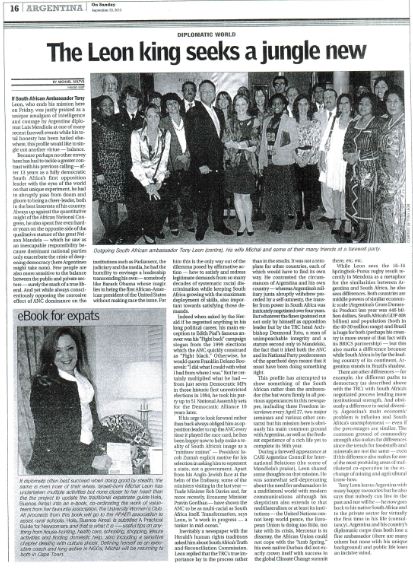
The Leon King seeks a Jungle New

Bookmark and Share

23 Sep 2012 | Michael Soltys | Original Publication: Argentina


Monday, August 27, 2012

Starting a new chapter

Bookmark and Share


27 August 2012| By Martin Williams  |  The Citizen Online

When South Africa’s ambassador to Argentina was in Johannesburg recently, he was required to fill in his name upon driving into a secured parking area.

 “You’re Tony Leon,” said the security guard. “I thought you were dead”. Leon related the story to me in the lobby of the Park Hyatt Hotel in Mendoza, a few hours before the Springboks faced Argentina at the Malvinas Stadium on Saturday.

We had pre-arranged this interview amid what was for him a busy week, crammed with receptions and business briefings centred on the ascension of the Pumas to what is now the four-nations Rugby Championship.

The previous evening, at a function in honour of the Springboks, Leon had shared with former Bok captain and current commentator Bob Skinstadt the experience of being a well-known face on TV.

“People assume a familiarity. They think they know you. And when you disappear they assume you’re dead, but you’re not. You’re  doing other things, off TV” said the envoy who will be leaving his post on September 28. Right there in the foyer, the accuracy of the first part of what he was saying was being played out.

We were continually interrupted by people, many of them strangers, wanting to shake his hand or have their photo taken with him. That’s in addition to the large number of Argentines and South Africans who actually know him  and greeted him in passing. Tony Leon is very much alive. It was clear from the several gatherings I attended that he has been active.

The Pumas’ first home match in the Rugby Championship,  with all the accompanying commercial buzz, is a fitting climax to  his brief diplomatic career which saw the volume and value of exports from South Africa to Argentina increase by 80 percent from 2010 to 2011, to reach R1.3 billion. The number of Argentines visiting South Africa has increased by 122 percent since 2009. Ever the diplomat, Leon praises his team. But it is clear from talking to a range of affected people that the energy that has driven SA’s mission for the past few years would not have been achieved without what Standard Bank’s boss in Argentina, Johan Roets, calls Leon’s “infectious enthusiasm”.

So, what lies ahead for Leon, who will be a mere 55 when he arrives back at his home in Cape Town? He is finishing his third book, The Accidental Diplomat: From Parliament to Patagonia. It won’t be as hard-hitting or as long as his 776-page On The Contrary, which explored some of his tough battles in politics, where he led the Democratic Alliance (DA) to new heights. Rather it will explain how he came to represent a South Africa led by Jacob Zuma’s ANC.

Leon will also serve a one-month fellowship at the Swedish-funded Stellenbosch Institute for Advanced Studies, where he will “interact with people much more intellectual than me. Basically you write, you talk. I will  do there in a more serious way what I’m doing in my book, which is to ask: ‘Where in the world is South Africa?’ “We have a whole set of foreign policy objectives. Do they align with what I think should be the diplomatic function, and with what our national priorities are? “We say they do but, as TS Eliot said: ‘Between the idea and the reality falls the shadow’.” In addition, in order to “put bread on the table”, he will be involved in some business. This will include trying to create more of a bridge between South America and Africa. We can also expect to see and hear more of him on the speaking circuit. A clear and articulate writer, he is likely to have regular bylines in several publications.

Earlier, in a separate conversation, a former colleague of his said it would be a waste for South Africa not to be able to use Leon’s considerable talents, suggesting he could be deployed in a corruption-busting role. I put this to Leon. If he had the opportunity, would he like to do a job in similar vein to that of the Public Protector? “I haven’t  thought of it. But I’m a little maxed-out on bureaucratic structures. “I  never say never, but I’m not aware of anything and I’m not looking for anything. I’m not in that market. “But I keep an open mind about things.”  

One thing he’s not going to do is go back into party politics. “You know, never step in the same river twice. The DA have got a leader and they are doing well. I will talk about it in my book. There are leaders for different eras. I was the leader in one era, and now it’s different.” Here’s his recipe for success in politics, diplomacy or in fact any career: “It’s probably clichéd but some clichés are based on repeated truths. You’ve got to be passionate about what you do, that’s the first rule of life, engagement. Don’t take yourself too seriously, and try to involve yourself in a cause greater than you.”

Although he did not start his diplomatic assignment with passionate intensity, after arriving in Buenos Aries he devoted himself to promoting South Africa, “to prove, not just to myself but to the world that you can actually do it very well and effectively without necessarily promoting the governing party, or the opposition for that matter. “You don’t have to be an ANC hack to serve South Africa. You certainly can serve South Africa from the opposition side and you can do it as effectively as anyone. “I became very passionate about the numbers. You’re no good if you can’t get the numbers up.” Well, he certainly succeeded in that, and in making South Africa more visible in Argentina.

Zenani Mandela-Dlamini, Madiba’s eldest daughter, will become South Africa’s ambassador to Argentina on October 1.

 • Follow Tony Leon on Twitter: @TonyLeonSA